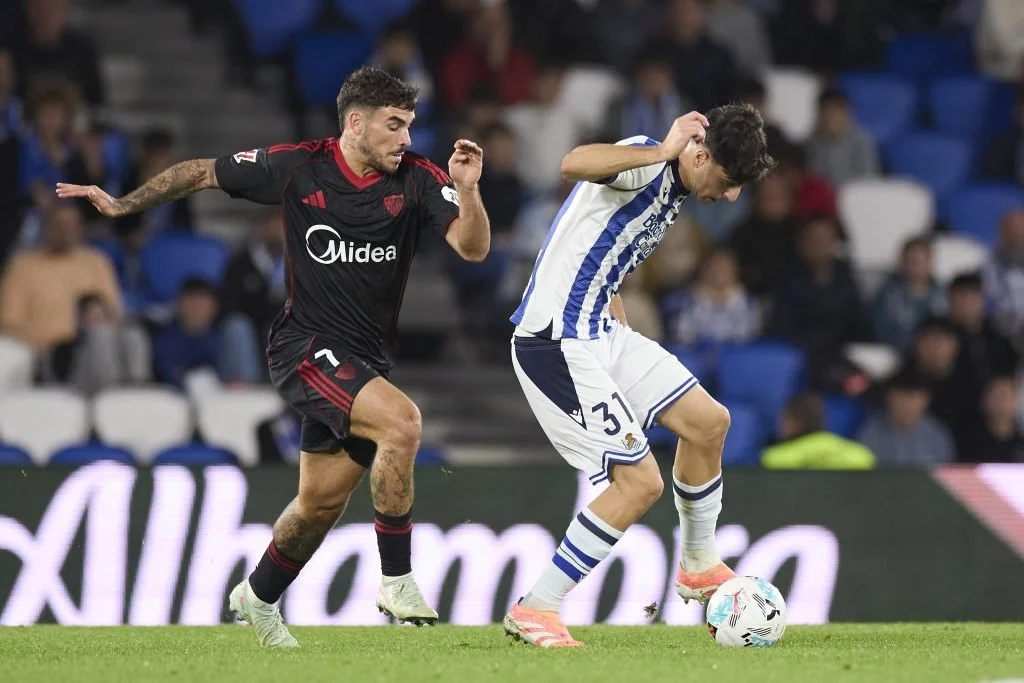
Sevilla FC Boss Matías Almeyda Drops Akor Adams After Barcelona Display, Defends Rotation Despite Defeat
Manager Matías Almeyda has revealed that his decision to bench Nigerian striker Akor Adams in Sevilla FC’s 2-0 loss to Valencia CF was based on dissatisfaction with the forward’s performance in their previous outing against FC Barcelona.
Despite Adams being Sevilla’s top scorer this season—with seven goals and several assists in 23 appearances—Almeyda opted to start Neal Maupay at the Estadio Ramón Sánchez Pizjuán.
The tactical switch failed to produce results, as Sevilla found themselves trailing by two goals before halftime, courtesy of strikes from Hugo Duro and Largie Ramazani.
In response, Almeyda introduced Adams at the start of the second half in a bid to turn the game around. However, Sevilla were unable to find the back of the net, ultimately falling to defeat.
Speaking after the match, the Sevilla boss defended his decision, emphasizing the need to test different attacking options.
“We have three strikers. I’m trying them out to see who scores the goals. I brought Neal back after his injury. I wasn’t happy with Akor’s last game, so we tried to rotate the squad. It’s very difficult to please everyone,” he said.

Opinion: Rotation or Risk? A Decision That Backfired
Matías Almeyda’s decision highlights one of football’s toughest managerial dilemmas—whether to stick with form players or rotate in search of better results.
On paper, rotation makes sense, especially in a demanding season. But dropping your top scorer, particularly when goals are already hard to come by, is always a gamble. In this case, it appears to have backfired.
Akor Adams’ numbers suggest he has been one of Sevilla’s most reliable attacking outlets. While one poor performance—especially against a strong side like Barcelona—may justify criticism, it rarely warrants immediate exclusion without a clear alternative ready to deliver.
The match also exposed a deeper issue: Sevilla’s attacking inconsistency. If the team struggles to score regardless of who leads the line, then the problem may go beyond individual players and point to a lack of cohesion or creativity in the system.
Ultimately, while Almeyda’s honesty is refreshing, results will determine whether such decisions are seen as tactical bravery or unnecessary risk.