Osogbo on the Eve: Thirteen Candidates, 25,310 Officers and the Saturday That Decides Osun
Osogbo goes quiet in the way a city does before something large. Inside the Central Bank of Nigeria's local office, ballot papers and BVAS units for Saturday's governorship poll sit under guard, waiting on a distribution run that will fan them out to all 30 local government areas in the roughly 24 hours before voting begins.
By Saturday night, Osun State will likely have a result, or at least the numbers to argue over one. Vanguard reports that thirteen candidates remain on the ballot for the August 15 election, which the Independent National Electoral Commission shifted from its original August 8 date to fit a revised national electoral timetable.
Only three of those thirteen campaigns are seriously contesting Government House. The other ten will appear on the same ballot papers now locked inside the CBN vault, footnotes to a contest that has already narrowed, in practice, to a three-way argument.
Thirteen Names, Three Real Contenders
The headline race is a three-way fight among incumbent Governor Ademola Adeleke, 65, now flying the flag of the Accord Party; the All Progressives Congress's Bola Oyebamiji; and the ADC's Najeem Salam, per Vanguard's rundown of the field.
The list got shorter by one just a week out. APGA's candidate, Adeyemi-Doro Adesina, withdrew from the race on August 8 and endorsed the APC — one contender folding into the frontrunners' arithmetic rather than testing it. Withdrawals this close to a vote rarely move numbers on their own, but they tend to signal where momentum is already thought to be running.
Ten other names remain printed on the ballot, representing parties whose presence is more procedural than competitive in this race. Nigerian state elections routinely carry a long tail of registered parties into contests that, in practice, resolve into a fight among two or three. Osun 2026 fits that pattern precisely: thirteen names, three campaigns actually built to win.
None of the three frontrunners can take Saturday for granted. A three-way race splits the vote in ways a straight two-horse contest does not, which means the margin separating first from second could end up thinner than any of the three campaigns would like this close to polling day.
A Security Footprint Without Precedent
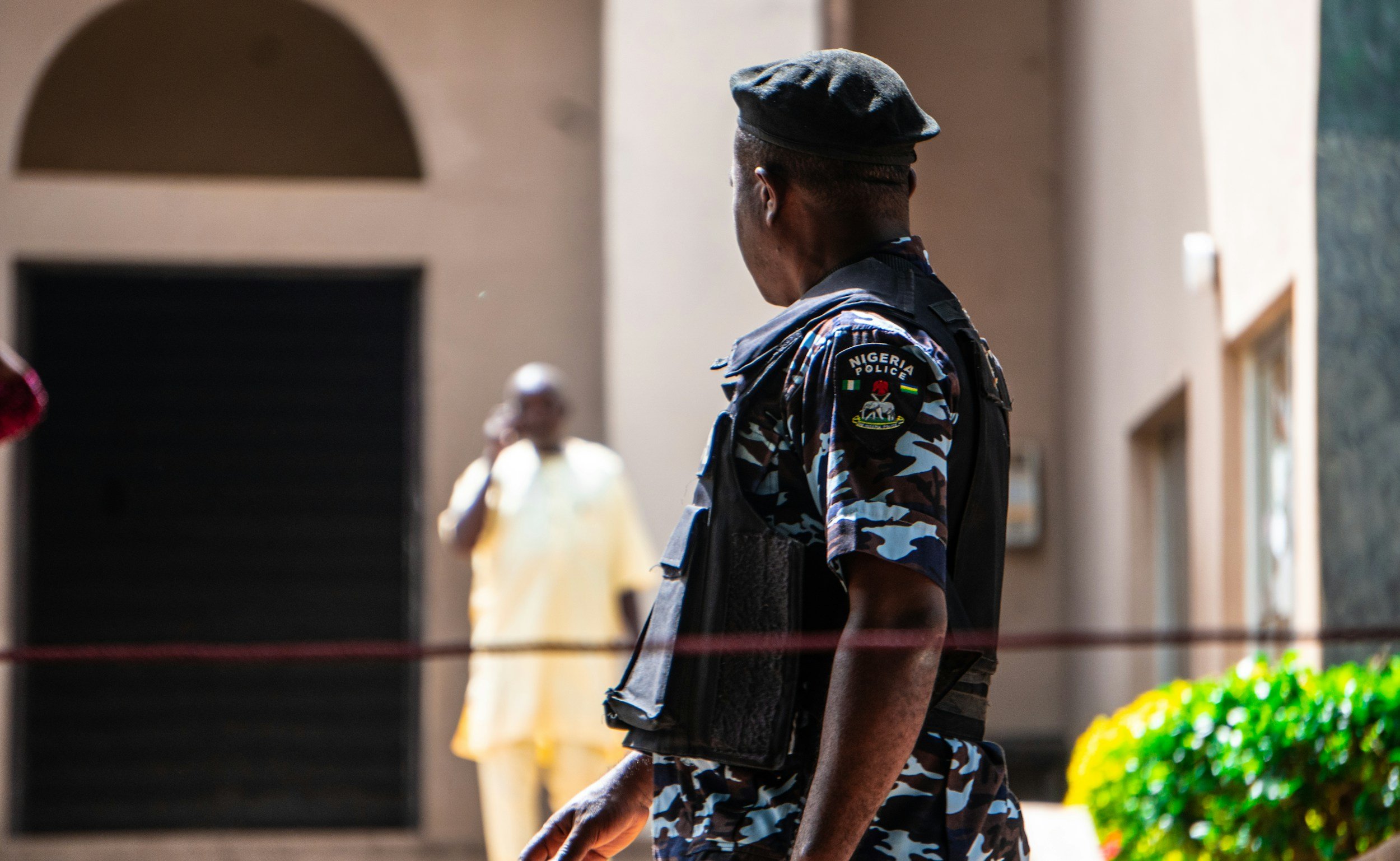
Nigeria has thrown an extraordinary security apparatus at a single state election. Punch reported that no fewer than 25,310 personnel — drawn from the police, the NSCDC and other services — are deployed across Osun, backed by helicopters, drones and mobile police units.
INEC itself is leaning on the National Youth Service Corps for manpower, drawing its ad-hoc election-day staff from a pool of more than 30,000 corps members, according to the same Punch report. Between the security personnel and the corps members, the number of people mobilised for a single state's governorship election runs past 55,000 — a logistics operation closer in scale to a national exercise than a state one.
Moving that many personnel and that many corps members into position inside a single week is its own operation, layered on top of the electoral one. Roads, accommodation, radios, fuel — the unglamorous mechanics of a deployment this size are usually invisible until something about them goes wrong.
The sensitive materials — ballot papers, result sheets, BVAS devices — were secured at the CBN office before distribution to all 30 local government areas began less than 24 hours before polls open. For a state that has seen its results disputed before, the chain of custody is being watched almost as closely as the count itself.
Tinubu's Dilemma
The president has a personal stake in this one. Osun is Bola Tinubu's ancestral home state, and the APC lost it in 2022. Premium Times framed the poll as a "Tinubu dilemma" — a test of whether the president can now deliver his own backyard to his own party.
On August 14, with barely a day to go, Tinubu addressed Osun voters directly. THISDAY reported that he urged residents to go out and vote for the candidate of their choice "without fear."
It is a carefully hedged line from a president whose own party has a horse in this race — an appeal to turnout dressed up as neutrality. No incumbent president wants to be seen instructing voters in his home state how to mark a ballot, especially not one his party could lose twice in a row. "Without fear" reads, in that light, less like routine civic encouragement and more like an acknowledgment that fear is already part of the conversation around this vote.
Losing Osun again would be difficult to explain away as a local anomaly, given whose ancestral home state it is. Winning it would let the president's party claim exactly the kind of home-turf validation it has lacked since 2022.
Adeleke's Countervailing Bet
Adeleke arrives at Saturday's vote as the incumbent, but not quite as the man voters first elected. He built his political base on one party's platform and defends Government House now under another's banner, having changed parties entirely since he last faced Osun's voters.
That switch means Saturday is not simply an up-or-down verdict on his first term. It is also a test of whether the coalition that elected him four years ago will follow him across a party line — whether loyalty in Osun politics attaches to the man or to the machine that first put his name on a ballot.
Personal-brand politics is not new to Nigeria, but rarely has it been tested this literally: the same man, the same voters, a different party badge, inside a single electoral cycle.
Set against Tinubu's dilemma, Adeleke's is the mirror-image bet: the president is trying to win back a state on party strength; the governor is trying to hold one on personal strength alone.
What Saturday Actually Tests
Strip away the convoys and the ballot logistics, and Saturday is deciding two separate questions with the same set of ballot boxes.
The first is about Adeleke: whether a sitting governor who changed parties can keep his base intact on a borrowed platform. The second is about Tinubu: whether a president can win back the one state where his name should count for the most, and has not since 2022.
Thirteen candidates, 25,310 security personnel, and one state carrying the weight of two separate political tests at once.
Both answers arrive from the same ballot boxes now waiting under guard across all 30 local government areas. Whatever Osun decides on Saturday, it decides for both men at once — an unusual coincidence for a single governorship race to carry.
Osogbo will not stay quiet for long.