Abuja's Nigeria Fashion Week Dangles a Walmart Shelf for Local Designers
Two Nigerian fashion weeks, one October. Lagos Fashion Week runs October 28 to November 1. Nigeria Fashion Week, a separate event entirely, runs October 2-4 — in Abuja, not Lagos, and with a pitch that has almost nothing to do with the runway itself.
The headline promise: a garment maker, an accessory creator or a textile manufacturer in Nigeria could, through this event, end up connected to Walmart's global retail ecosystem. That's the deal organizers are building, and it's why Nigeria Fashion Week 2026 is being described less as a fashion show and more as trade infrastructure with a runway attached.
It's an unusual thing for a fashion week to lead with. Most events sell tickets on designers, celebrity attendance and photographs. This one is selling a supply chain.
Two Nigerian fashion weeks, three and a half weeks apart: Lagos Fashion Week runs October 28-November 1; Nigeria Fashion Week runs October 2-4, in Abuja.
Not to be confused with Lagos
The first thing worth clearing up: Nigeria Fashion Week and Lagos Fashion Week are not the same event. Lagos Fashion Week has its own established October dates, October 28 to November 1. Nigeria Fashion Week, organized separately and staged in Abuja, runs earlier in the month, October 2-4. Two cities, two organizations, two runways, three and a half weeks apart on the same calendar.
That distinction matters more than it might first appear. Lagos Fashion Week has, over the years, built international recognition as the country's flagship showcase. Nigeria Fashion Week is not trying to be that same thing in a different city — its theme and program suggest an event carving out a different lane entirely, built around industry and policy rather than star power.
Nigeria Fashion Week's 2026 theme is "Beyond the Runway: Fashion and Culture at the Heart of the Green & Blue Economy" — its fifth "Going Green" edition — which signals upfront that the runway itself is not the point organizers are selling hardest. The name of the theme alone tells you where the emphasis sits: economy first, culture second, runway framed as backdrop rather than headline.
It's a deliberate contrast. Where a flagship fashion week tends to be judged on star wattage and front-row photographs, an event built around a fifth consecutive "Going Green" edition is asking to be judged on a different scorecard entirely: recycled fashion collections, tree-planting numbers and trade partnerships, not just who sat where.
The Walmart pipeline
The point they are selling is this: organizers, led by Nigeria Fashion Week president Lexy Mojo-Eyes, have partnered with New York-based Bizness Group to connect Nigerian garment makers, accessory creators and textile manufacturers with Walmart's global retail ecosystem, according to ThisDay. For a Nigerian textile or garment business, that is a direct line most local fashion weeks simply don't offer — not press coverage or a runway slot, but a shelf, in a retail chain most Nigerian producers would otherwise have no route into.
That's a materially different value proposition than a typical fashion week gives its exhibitors. Runway exposure builds a brand's profile. A Walmart connection, if it converts into actual purchase orders, builds a business's revenue — at a scale a single Nigerian retail relationship rarely could. Whether that partnership produces actual contracts, or stays at the level of introductions and trade-fair conversations, is the detail worth watching once the event itself happens in October.
It's worth being precise about what has actually been confirmed so far: a partnership connecting Nigerian producers to Walmart's ecosystem, not a guaranteed set of purchase orders. Trade partnerships of this kind typically open a door, introductions and a pathway to supplier vetting, rather than delivering signed contracts on day one. The October event itself is likely where that distinction becomes clearer.
Government behind it
The event also has an official government voice attached. Minister of Art, Culture, Tourism and the Creative Economy Hannatu Musa Musawa reaffirmed federal government support for Nigeria Fashion Week in an announcement reported in August 2026, per The Guardian. That backing sits alongside the Walmart partnership as a second signal that organizers are pitching this event as economic policy as much as culture — a creative-economy project with a minister's name on it, not just a fashion calendar entry.
Having a sitting minister publicly reaffirm support gives organizers something a purely private fashion week can't claim: a degree of state backing behind the Walmart pipeline, and a signal to Nigerian manufacturers that this isn't a one-off trade-fair experiment but something government is treating as part of a broader creative-economy push.
What's actually on the program
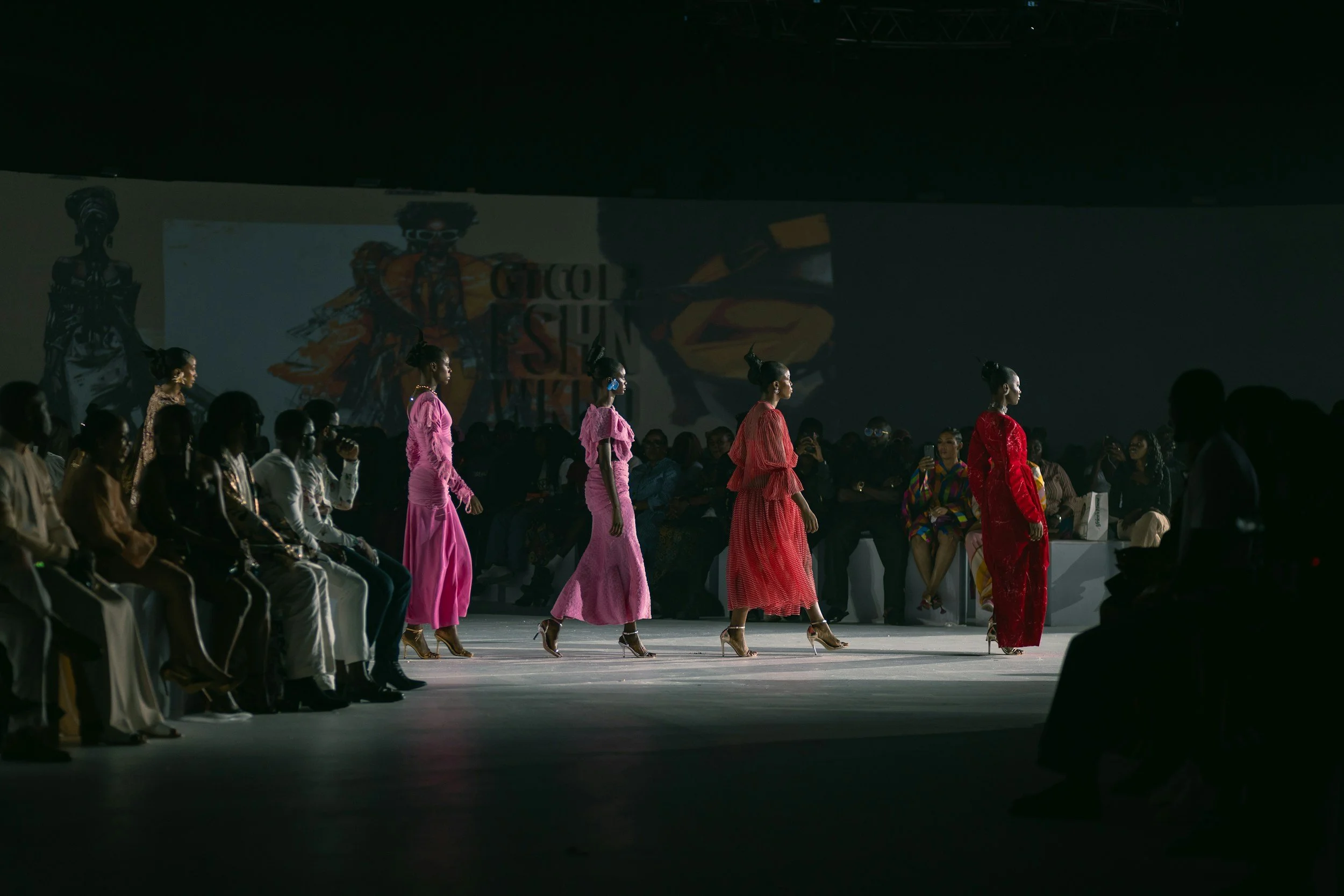
Strip away the trade-and-policy framing and there is still a fashion week underneath it. The program includes six major runway showcases, plus a "Going Green Collection" built entirely from recycled and upcycled fashion, a "Trees for Nigeria" tree-planting campaign, and the Nigeria Fashion Awards, per Innovation Village. It's a mix that tries to hold three identities at once: environmental campaign, industry trade fair, and awards-night spectacle.
Six runway showcases is a substantial program by any standard — enough to give Nigeria Fashion Week genuine claim to being a real fashion week, not just a trade summit with a couple of token catwalks bolted on. The environmental layer, the "Going Green Collection" and the tree-planting campaign, gives the event a sustainability identity distinct from whatever Lagos Fashion Week's own October program turns out to include.
The Nigeria Fashion Awards, tucked at the end of that program, is the one item that functions as a conventional fashion-week close: recognition, a ceremony, a night that photographs the way audiences expect a fashion week's finale to look. Even an event built around industrial policy still needs a closing spectacle.
Runway spectacle or industrial policy?
Whether that mix holds together is the real question hanging over October 2-4. A "Going Green Collection" and a "Trees for Nigeria" campaign are the kind of program items that photograph well but don't, on their own, move product. The Walmart connection is the part with teeth — an actual retail pipeline, not just a stage. If it delivers even a handful of Nigerian manufacturers into Walmart's supply chain, Nigeria Fashion Week will have done something Lagos's glossier October dates never promised to do.
Seven weeks out, that promise is still just a partnership on paper. October will say whether it's also a shelf.